Apart from rock and roll, as you can easily understand, I just love vintage junk. The Curtiss V-8 motorcycle was mentioned by me quite slightly and casually in an article about Boss Hoss with a V6 engine. What finally prompted me to write a separate article about the Curtiss V-8 was the following fact: just four months ago, on a Jay Leno show, someone named Dale Stoner rolled up an exact replica of the original motorcycle, which you can listen to, and even ride, and admire in motion.
But let’s start with the story of our current star. Once upon a time, Glenn Hammond Curtiss lived at the very end of the 19th century. At first I was engaged in bicycles – racing them, selling them, courier work, and everything else. In 1900, internal combustion engines became a little more accessible, and Mister Curtiss became interested in such units, and at the same time, of course, motorcycles too. Glenn Hammond built his first carburetor from a can of tomato soup, which contained gauze that absorbs gasoline due to capillarity. Already in 1903, Curtiss set the first motorcycle speed record: 103 kilometers per hour on a Hercules V-Twin motorcycle, which immediately brought Glenn some fame.
In particular, Thomas Scott Baldwin, one of the pioneers of aeronautics, became interested in Mister Curtiss’ engines. Glenn’s units were among the most powerful, reliable and, at the same time, lightweight at that time. Therefore, Baldwin ordered a certain number of engines from Curtiss. In 1904, the first airship appeared in America: the California Arrow, which conquered the air with the help of a Curtiss 9 HP motorcycle engine. In view of all this, Glenn Curtiss became seriously interested not only in land vehicles, but also in air vehicles.
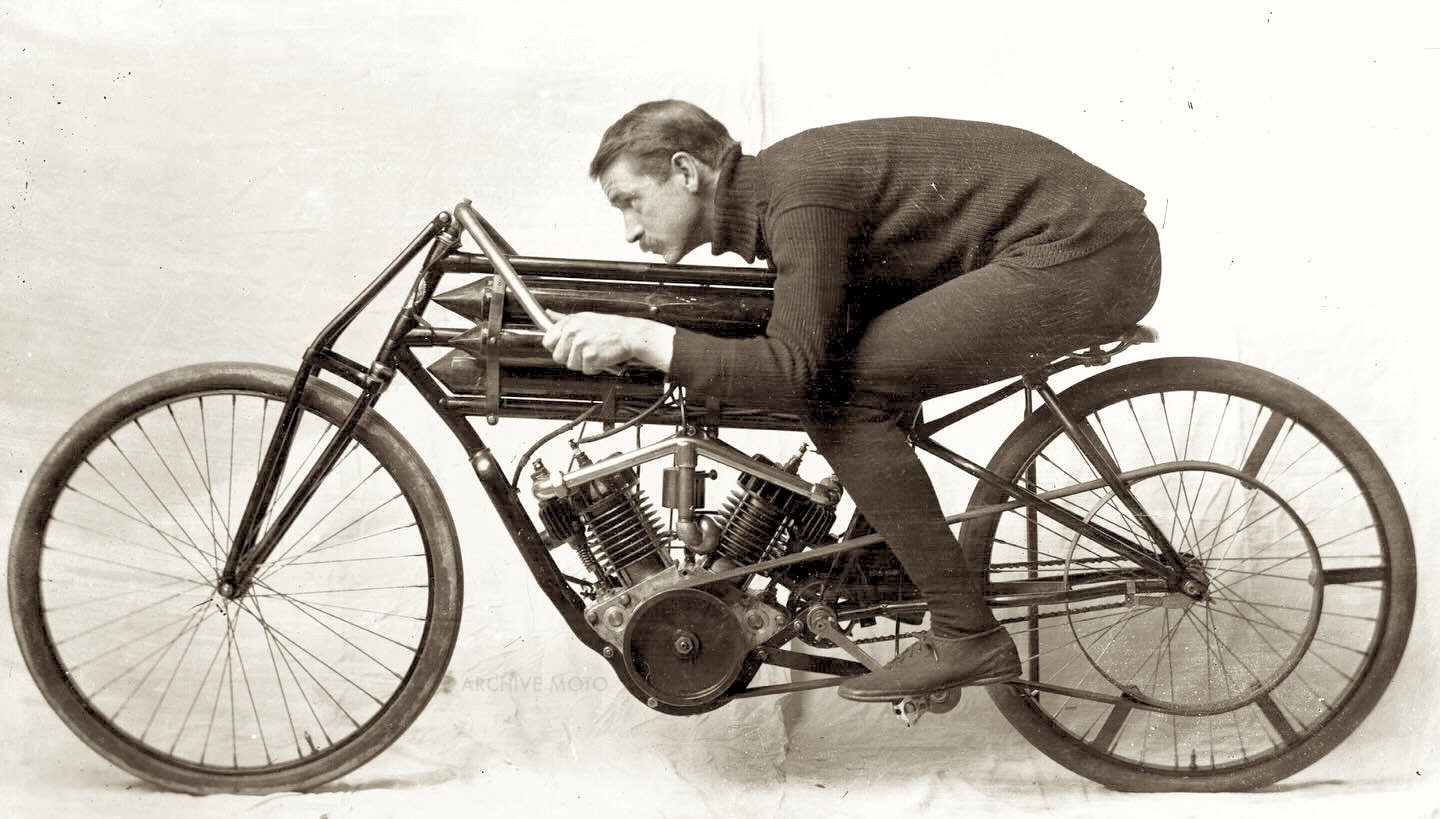
And so, in 1906, Mister Curtiss develops a new engine: a 40-horsepower V-eight called the Curtiss B-8, which Glenn plans to put on airships. However, the engine needs to be tested. And a completely logical decision is made: it is better to test on the ground. No matter what happens on the ground, it will still be better than if something happens in the air. After all, airships at that time were filled with hydrogen, so a jamb in the engine could well lead to a fun fire show in the air. And the first helium airship, let me remind you, will appear only in 1921…
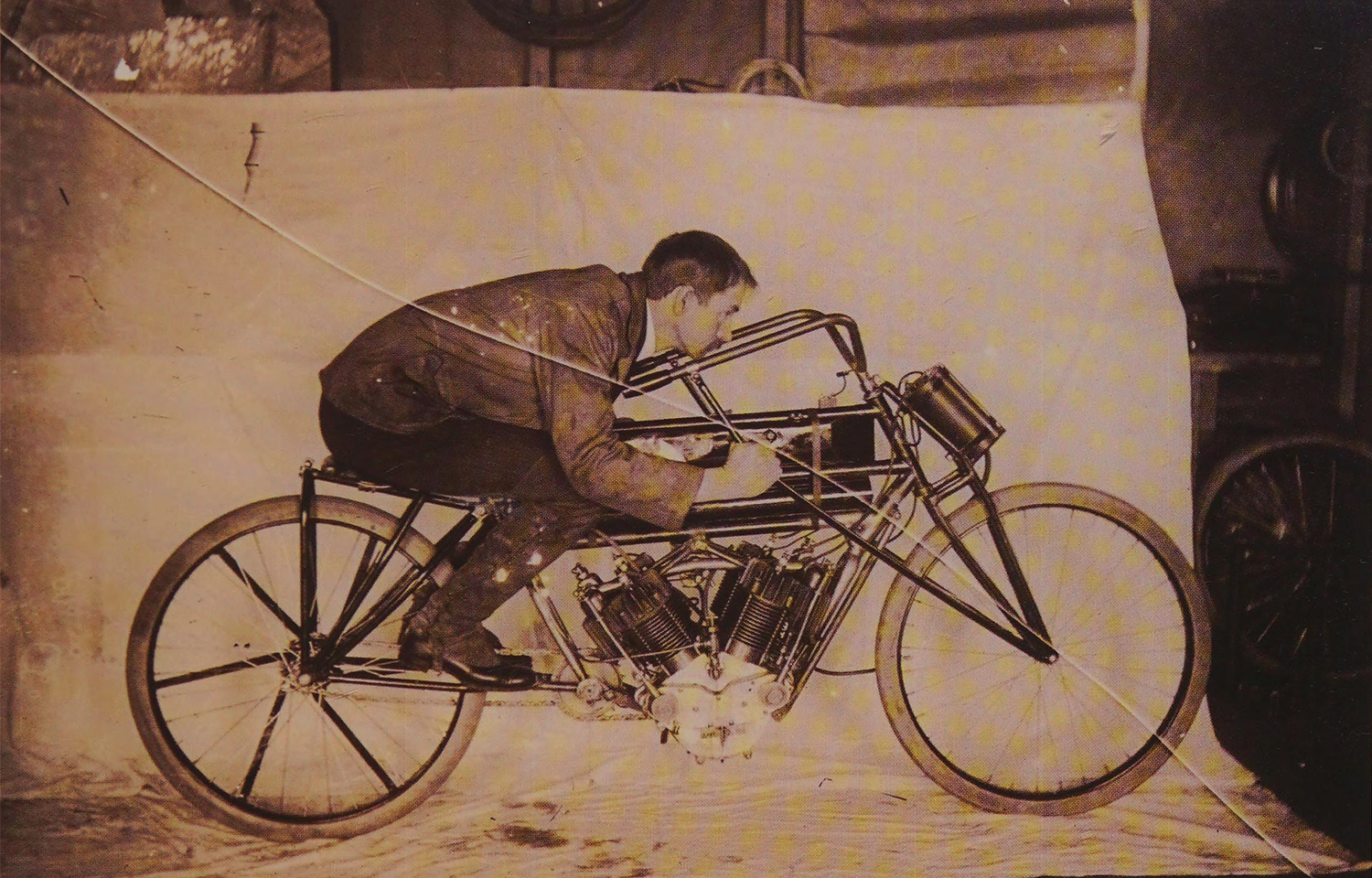
In general, no one wants to wait 15 years, but they really want to fly. Therefore, after conducting a couple of initial tests and making sure that everything looks to be working, Glenn Curtiss decides to check the engine in action. He attaches the steering wheel and wheels to the test bench, calls it a motorcycle and goes to set a new speed record. All right, all right. Glenn probably made the frame after all, and didn’t attach the wheels to the test bench, but by God. There is so much nothing superfluous about the Curtiss V-8 motorcycle that the stand-up theory seems quite plausible.
The original motorcycle is still alive, is in the Smithsonian Institution and is carefully preserved. At some point in its history, it was restored by the guys from the Glenn Curtiss Museum, and it was thanks to his connections at the museum that Dale Stoner was able to build as accurate a replica as possible. The museum provided Stoner with about a hundred pages, where absolutely all the nuances of the record-breaking motorcycle were recorded in great detail. In addition, Dale was able to get an engine that he was allowed to disassemble, and another, completely fresh Curtiss V8 was built using reverse engineering methods. https://www.youtube.com/watch?v=4rvpRihxaLs
The engines at that time were, of course, so-so: they quickly failed and were replaced with new ones (which, in general, is quite expected when cans of tomato soup are quite a competitive part). Specifically, the engine that Mr. Stoner disassembled was in a deplorable state. According to Dale himself, “they were lucky that it didn’t explode.” Therefore, although the remark was very approximate, Stoner still allowed himself a few liberties, because he was going to ride a motorcycle and did not want the engine to break down after a couple of thousand kilometers. More durable materials were used, the lubrication system was improved, and balancing with all measurements was performed on modern equipment – much more accurate than that which was at the beginning of the last century. More specifically, a small oil pump and filter did appear in the replica motorcycle, simply because the banal spray lubrication in an eight-cylinder 4.4-liter engine sounds naturally scary. Dale also didn’t like the condition of the driveshaft in the engine that came into his hands, and he took a much more modern one – something on the level of what can be found in a classic Mustang or Camaro. https://www.youtube.com/watch?v=V4mXq4RzqaI
Aluminum pistons were also installed instead of iron pistons, which first appeared in engines only a little later, during the First World War. After revving the engine on the stand, Dale discovered that to accelerate to Glenn Curtiss’ record speed, the V8 needed to gain only 1,675 rpm. Having decided that at the age of 70 he was not going to set new speed records, Stoner set the transmission one to three in order to slow down the resulting motorcycle slightly.
Everything else was left the same as on the original motorcycle. The same narrow white wheels. There is only one brake on the rear wheel, and even that is just a piece of metal rubbing directly against the rubber. The crankshaft, camshaft and gears are without any lubrication system. You drip oil on them from a jar before the trip – and go ahead, conquer the highways. The same carburetor, albeit a new one: carburetors of this type are still in production. The cylinder heads were made using modern technology: Mister Stoner created a 3D model, which was used to print a mold for casting on a sand 3D printer, and the cylinder head was already cast into this mold. The method of the 21st century, but the detail itself is one-on-one, as in 1906. For ignition, Dale nevertheless developed a backup electrical system, although the original antediluvian kickstarter is also available and fully operational. Even the 6 volt battery cells strapped in front of the rider are still in place. This collective farm element is there because Curtiss did not really test his motorcycle, and almost before the race he discovered that the calculations had failed and the ignition system did not have enough electricity. The new batteries were hastily installed, and Stoner just wanted his bike to look exactly like the original bike looked on the day the speed record was set. https://www.youtube.com/watch?v=jak3oEGahnE
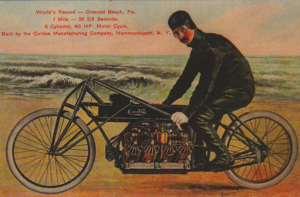
And so, back in 1907, on this magnificent flying saucer, Glenn Hammond Curtiss rolls into Ormond Beach, Florida, and reaches a speed of… 220 kilometers per hour! No, seriously. Can you even imagine 220 on this? Why is there 220 – at least 120? On that narrow white rubber? With this geometry? With this landing? With a metal stick instead of brakes? And even on the beach, God forbid, on the sand!
As mentioned in the article about Boss Hoss, Curtiss’ record was beaten only in 1911. By car. Among motorcyclists, Glenn Hammond remained the fastest until 1930. And I’m one hundred percent sure that it’s not that no one could build something that could theoretically go faster. The thing is, it definitely took more than nerves of steel to accelerate a two-wheeled car of those days to over two hundred. It was necessary to literally know no fear and laugh death in the face. Curtiss was a crazy son of a bitch, and I hope God gave him a car in heaven to match.
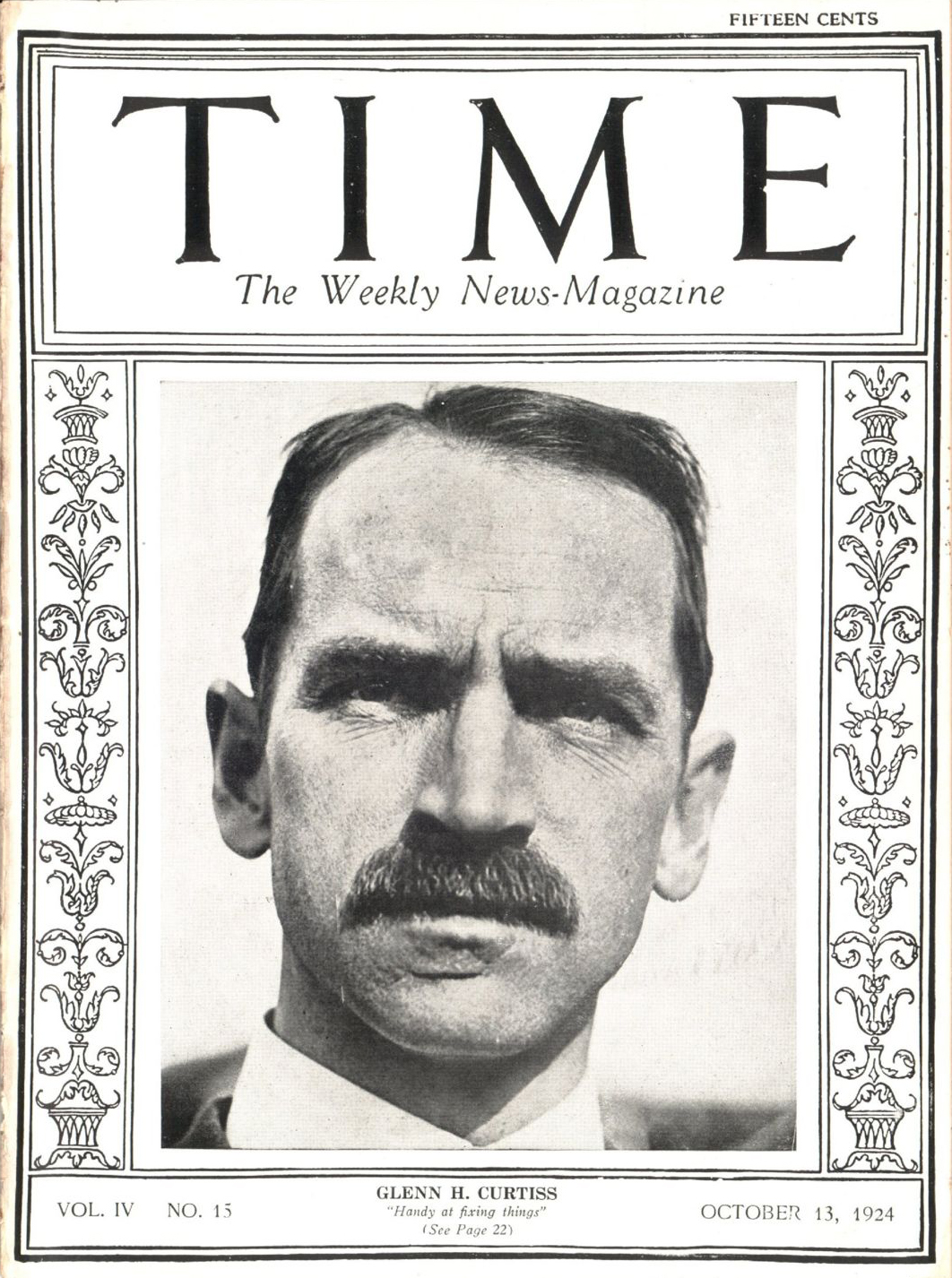
On the track itself, Mr. Curtiss was out of the standings, as his bike was not standardized, and at that time nothing else was allowed to the official standings. Besides, it was necessary to drive in two directions, and Glenn drove only one way: after such madness, the motorcycle refused to go back, breaking his crankshaft. Nevertheless, although the record did not become official, 220 kilometers per hour on two wheels in 1907 made many people open their mouths in surprise: Curtiss became a sensation and gained fame. The B-8 engine proved itself, and forty horsepower went to conquer the airspace. Subsequently, Glenn would still fight with the Wright brothers, win many air races and competitions, and appear on the cover of Time magazine on October 13, 1924… In general, his wild feat, bravery and engineering skills did not go unnoticed, and Glenn Hammond Curtiss is remembered to this day, not least for his love of cars and high speeds.