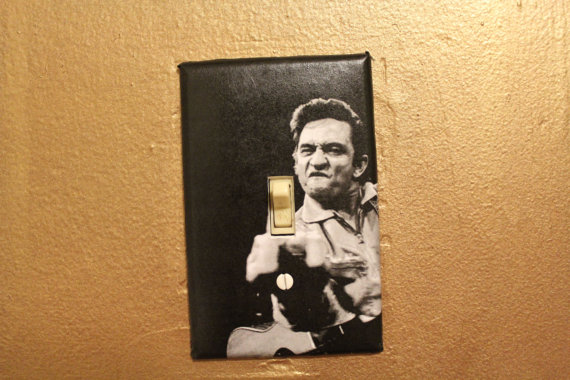
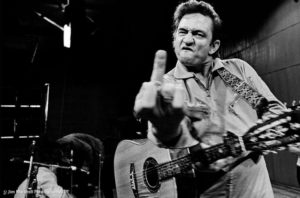
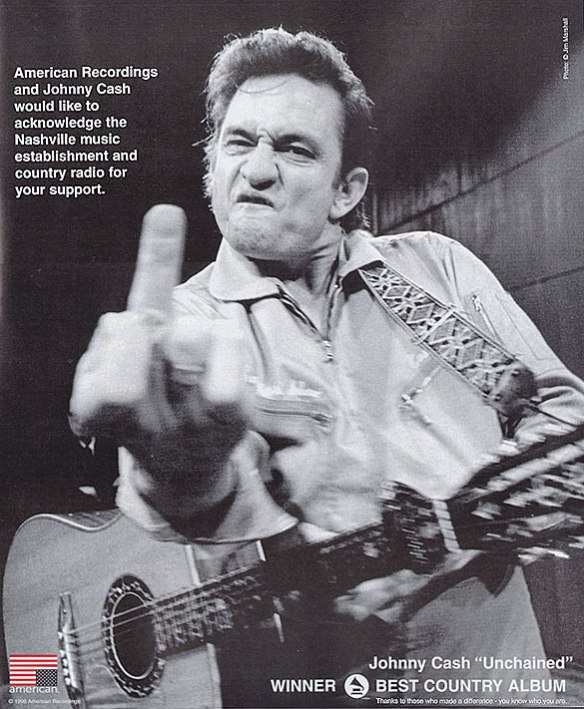
One of the most famous music photos in history is Johnny Cash giving the middle finger, popularly known as “the bird”. Usually, such iconic photos first appear on glossy album or magazine covers. However, this is not the case here. By the time the photo became infamous, almost twenty years had passed since its appearance, and to this day, most of Cash’s fans do not know the true story of its creation.
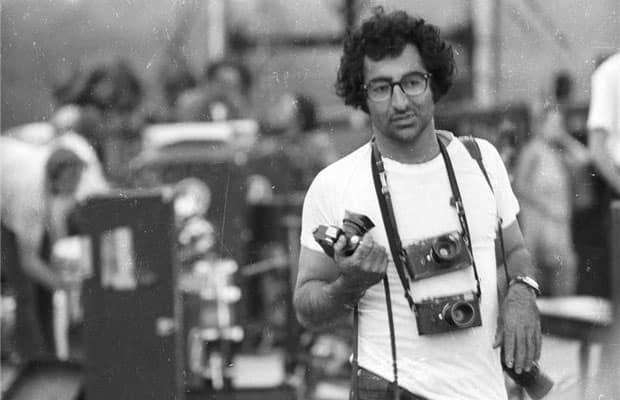
The name of Jim Marshall, now an iconic photographer in the music industry, was little known in the 1950s. He started with photographs of John Coltrane and quickly became in demand by major music labels, having participated in the creation of more than 500 album covers throughout his career. He was hired by The Beatles to film their last concert in 1966. Marshall took some of the most famous pictures at the Monterey Pop Festival, Woodstock and many other historical events. Marshall is considered the first true rock photographer and perhaps the greatest in the history of rock music.
Marshall first met Johnny Cash in 1962 at a Greenwich Village cafe, and they were introduced by Bob Dylan, who was often photographed by the photographer. They immediately hit it off, and their 30-year creative collaboration began. Marshall first photographed Cash at folk festivals, and then in 1968, at Johnny’s insistence, he was hired by Columbia Records to film the recording process of the famous album “At Folsom Prison”.
The idea of recording a concert in prison had been discussed for years, and after a reshuffle at Columbia, Cash gained a supporter of the project in the person of producer Bob Johnston. Cash’s connection with prison themes began with his first big hit, “Folsom Prison Blues,” inspired by a movie he watched while serving in the army in West Germany in the early 1950s. Although Cash himself never served a prison sentence (although his seven arrests included overnight stays in prison cells), he received letters from prisoners and performed regularly in prisons starting in 1956.
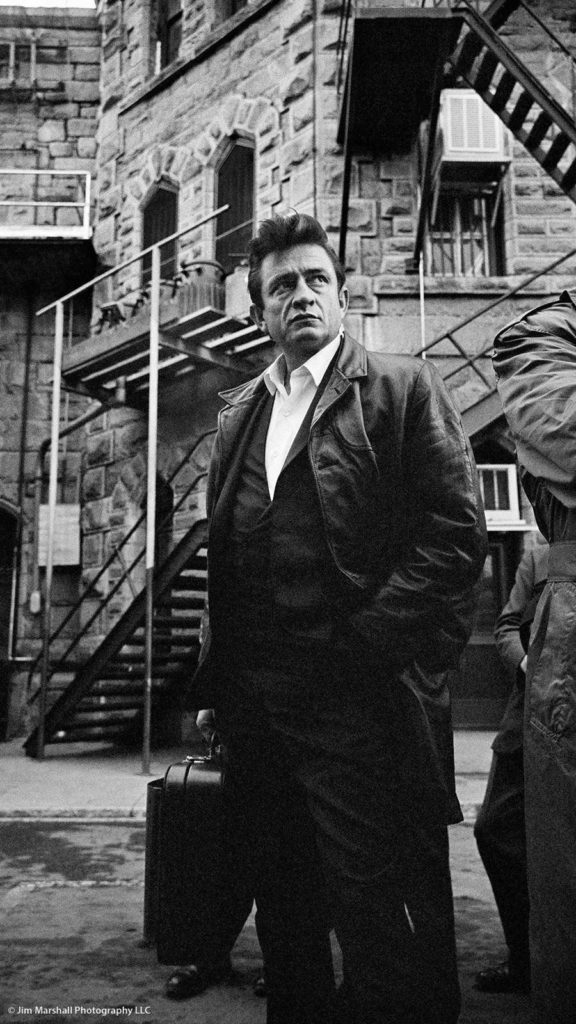
Columbia Records took a risk by recording the country legend in prison – Cash had only recently overcome his addiction to drugs and booze. The idea of recording and filming, in addition to the obviously chosen Folsom prison in Northern California (in which, among other penal institutions, Cash had previously given a concert in 1966), was proposed to several prisons, including San Quentin, but Folsom responded faster and therefore the recording of the album took place there, on January 13, 1968. “At Folsom Prison” topped the country charts and revived the artist’s career.
After Folsom’s success, Columbia Records released the compilation Heart Of Cash, and in early 1969, The Holy Land album with religious songs. Despite the change of theme, the album reached number 6 on the country charts, and the single “Daddy Sang Bass”, written by Carl Perkins, by that time Cash’s regular guitarist, stayed at the top for six weeks. The logical follow-up was the recording of another live album at San Quentin Prison, where Cash had already performed three times.
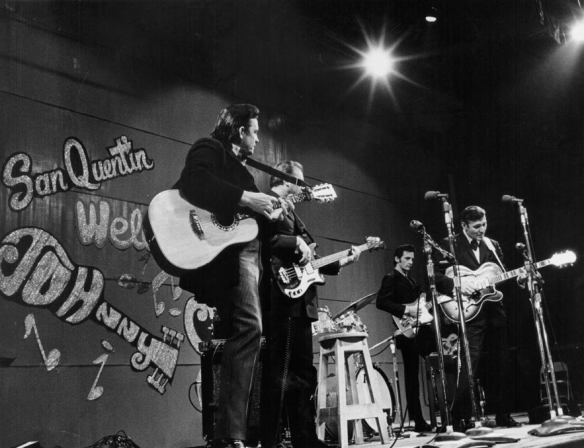
On February 24, 1969, Marshall and the Granada Television crew arrived in San Quentin to prepare for the show. The famous picture was taken not during the recording of the concert, but the day before during a rehearsal, where Cash was dressed in a prison robe (later sold at auction for $50,000 with a starting price of $3,000-5,000). At the concert, Cash demonstrated disobedience to the producers: before the song “I Walk The Line”, he complained to the prisoners about the demands of the administration.:
“They said: “You have to sing this song, you have to sing that song.” You know, “you have to stand like this or act like this.” I just don’t get it, guys. You know, I’m here to do what YOU want and what I want.”
And he performed his bitter and vital song “San Quentin” twice in a row due to the enthusiastic reaction of the audience:
Johnny Cash – San Quentin (Live)
The San Quentin album surpassed the success of its predecessor, topping the pop album chart for five weeks in the fall of 1969 and winning a Grammy as Album of the Year. The version of “A Boy Named Sue” reached number 2 on the pop singles chart. Both prison albums had reached three million sales by 2003.
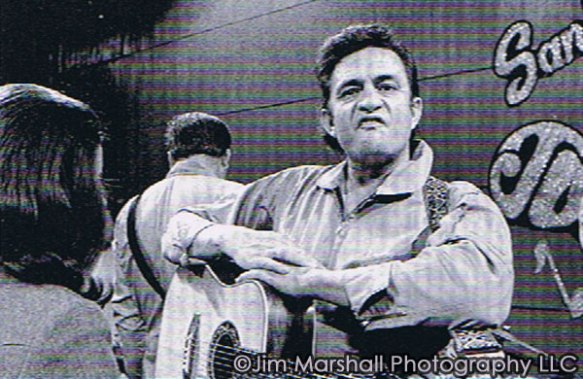
The photo with the middle finger was not used in the original design of the album released on June 4, 1969. It remained virtually unknown for about 20 years, appearing only in exhibitions of Marshall’s photographs. In the late 1980s, posters and T-shirts with the image began to appear in music stores. Marshall called this picture “the most stolen photo of all time.” In his book Not Fade Away (1997), the photographer offered two versions of the gesture:
“I forgot why he showed “the bird” in this picture, perhaps it was addressed to the television crew that was filming there, or maybe I suggested making a special shot for the prison governor, but for some reason this photo became very famous, iconic…”
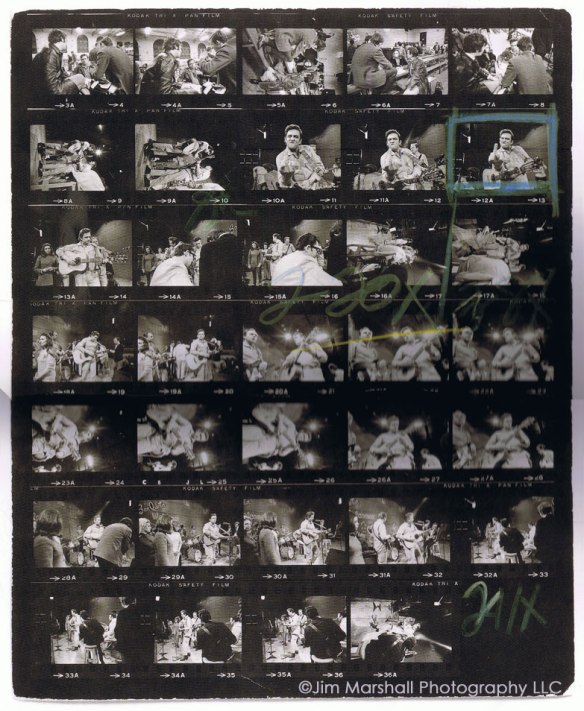
There are three shots with the middle finger, shot by Marshall at the rehearsal. The third one, marked with a blue pencil, became famous. Marshall used a 21mm lens.
In 2000, when reissuing the album on CD, Johnny Cash explained in his notes the gesture of dissatisfaction with the film crew, blocking the prisoners’ view. However, Cache’s version is at odds with the facts: the picture was taken at a rehearsal, not at a concert.
Before this became known, people often assumed that Cash was annoyed by whoever was taking the picture. He’s definitely looking directly at the photographer, but giving the middle finger to Jim Marshall was nothing new, even in 1969. Marshall was a self-proclaimed tough guy (“… cars and guns brought me a lot of problems, but cameras didn’t”), but he was appreciated by those he photographed, which is why he got such personal, expressive pictures. That’s why Cash asked him to shoot in both Folsom and San Quentin. “…The gesture was definitely meant as a joke. Johnny has a great sense of humor, and it wasn’t a serious shot.”
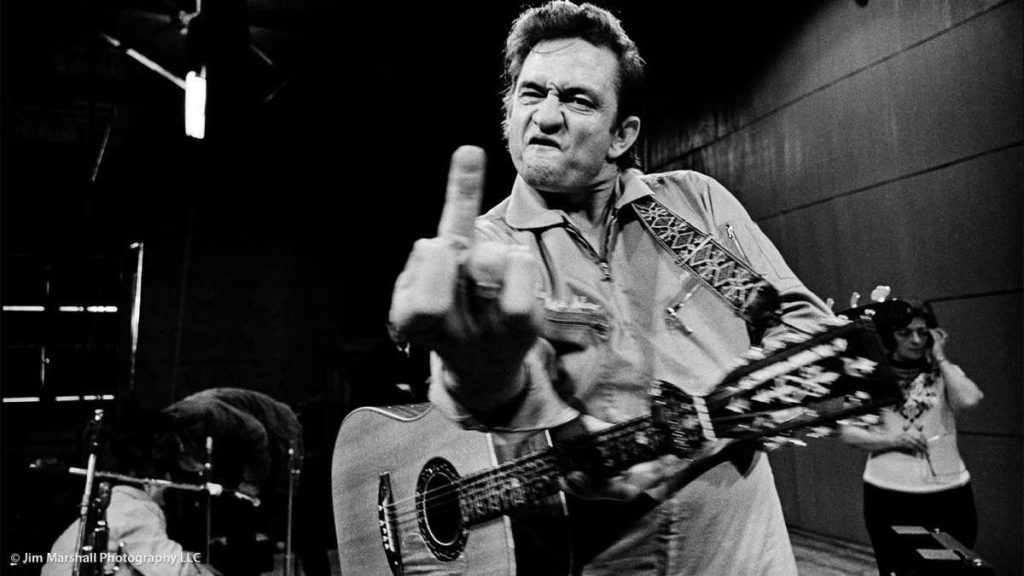
Cash downplayed the scandalous nature of the photo, noting that his mother-in-law was standing behind him, and there was an engagement ring on his other finger. The Man in Black was an outlaw country legend adored by prisoners around the world, but he was also a religious man who constantly struggled with his demons. The fact that Marshall knew about Johnny’s desire to do the right thing probably contributed to the fact that the photo remained unpublished for so long. Bill Miller, a close friend of Johnny Cash, commented:
“I can tell you that Johnny didn’t like this photo and he didn’t like signing it even more.”
In the 1990s, Cash’s career enjoyed a new upswing thanks to his collaboration with producer Rick Rubin. Their first album together, 1994’s American Recordings, was the quietest album Cash had ever made, recorded with only him and his acoustic guitar in Rubin’s living room. The album was a huge success and won a Grammy for Best Contemporary Folk Performance. Suddenly, Johnny was playing to a young audience of thousands at the British Glastonbury Festival, and appeared as a coyote in an episode of The Simpsons. It was such a pleasant surprise for Cash that he agreed to do something new for the second album with Rubin, Unchained (1996) recorded with the participation of Tom Petty & The Heartbreakers.
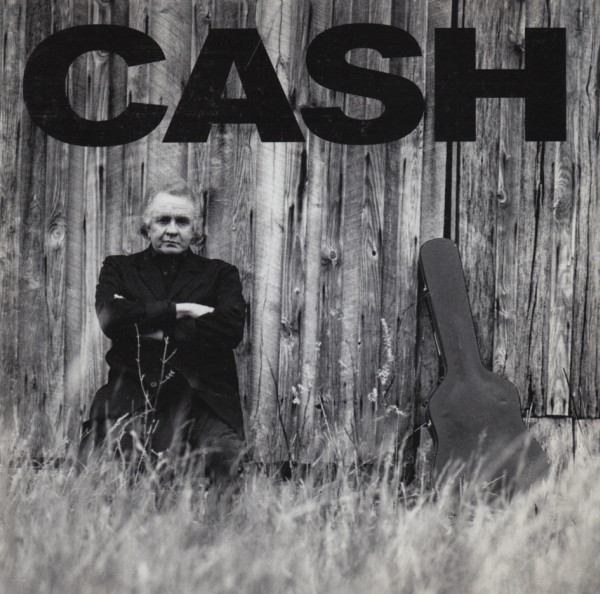
Before American Recordings, Cash was hesitant to make a record that consciously appealed to Generation X. Rubin assured him that he wanted to do everything Johnny’s way and see what would happen. Having Tom Petty & the Heartbreakers as an accompanying band on the album kept him in the country rock world, but now he sang Beck and Soundgarden songs with Flea on bass. If the Lollapalooza audience used to just love him, now they adored him.
Grammy representatives from the National Academy of Recording Arts and Technology have a long-standing fondness for veterans, and indeed, Unchained was nominated for two Grammys in 1998: “Best Male Vocal Performance” for “Rusty Cage” (went to Vince Gill for “Pretty Little Adrianna”) and “Best Country Album” – this nomination Cash had won, beating Alan Jackson, Patty Loveless, George Strait and Dwight Yoakam.
Johnny Cash – Rusty Cage (1966)
Modern country radio ignored Cash for years. An austere album like American Recordings would have sounded completely out of place next to the sleek young pop-cuntry stars of the time, although Unchained had a full-fledged country rock band behind it. However, the record did not receive any love from American country radio stations and no nominations at that annual Country Music Awards (CMA). It’s time to stand up to them.
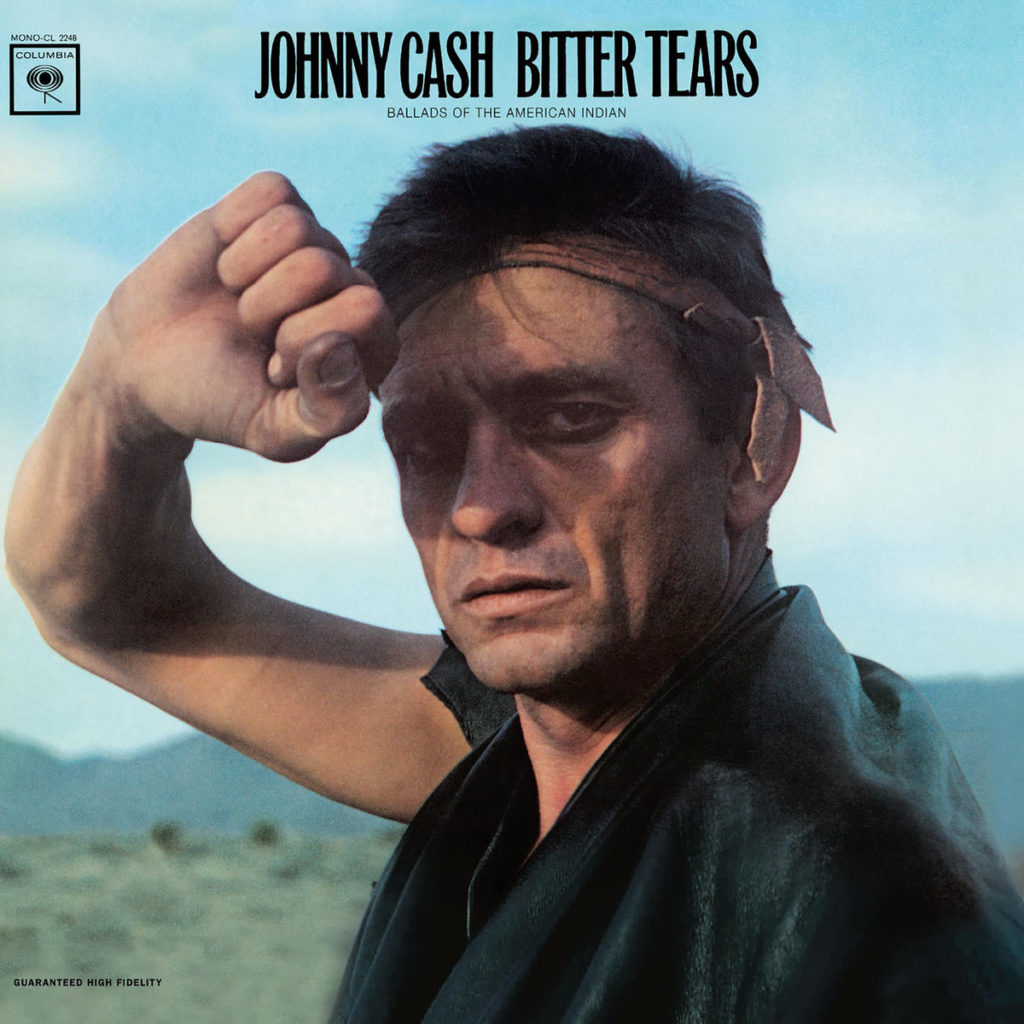
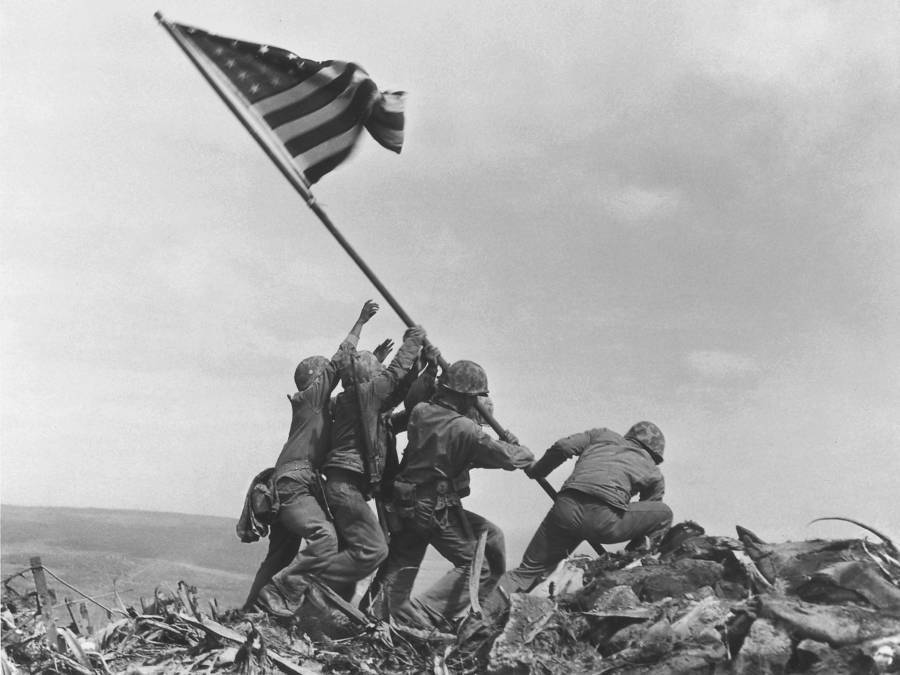
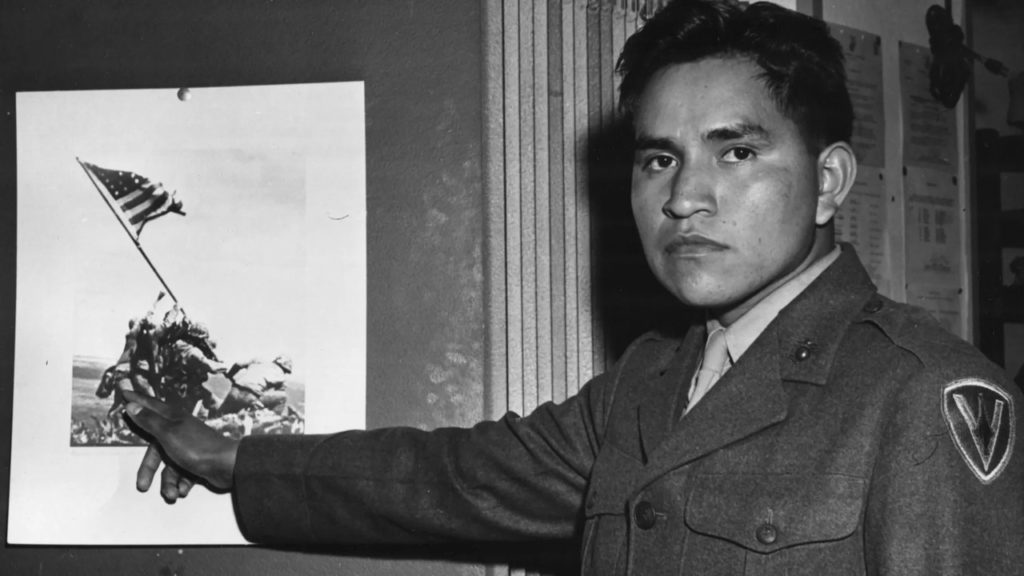
In 1964, Cash had already used public pressure tactics on the industry, then he immersed himself in the history of American Indians and how the US government treated them. He recorded an entire album called Bitter Tears. When radio stations boycotted his single “The Ballad of Ira Hayes,” about a Native American war hero from the Pima tribe who was immortalized in a famous photograph from Iwo Jima but died a penniless alcoholic, he posted an open letter in Billboard as a full-page advertisement criticizing the cowardice of program directors. The song reached number 3 on the country charts.
Johnny Cash – The Ballad of Ira Hayes (1964)
“DJs — station managers — owners, etc., where are your guts? I think you have guts – that you believe in something deep inside (And forgive the dialect – mine is one of 500 or more in this country). However, the actual sales of “Ira Hayes” are twice the average sales of “big country hits.” Classify me, categorize me, STRANGLE me – but it won’t work. These texts bring us back to the truth. You’re right! Teenagers and Beatles record buyers don’t want to hear this sad story of Ira Hayes, but who can easily cry and who goes to see sad movies to cry??? Teens. Yes, I record records to try to achieve “sales”. Another word we could use is success. Despite the charts of the country music industry – categorization, classification and restrictions on rotation, this is not a country song, not in the form in which it is sold. Although this is a great reason for bezyatsevs to give her a thumbs down. Ira Hayes is a powerful medicine. Like Rochester, Harlem, Birmingham and Vietnam. But as an American who is almost half Cherokee-Mohawk (and who knows who else?), I had to fight back when I realized that so many radio stations were afraid of Ira Hayes. Just one question: WHY???”
So in 1998, Rick Rubin, inspired by the story of 1964 and the recently seen picture with the middle finger, suggested playing by Cash’s rules again and placing provocative ads on Billboard. Cash supported the idea, and they wrote the lyrics together, with Cash insisting on the wording “Nashville music establishment” instead of just “country radio.” The advertisement, which cost $20,000, featured a photo of Cash with a caption ironically thanking the industry for the lack of support for his new albums.
The announcement caused a wide response among musicians. Willie Nelson hung it on his tour bus, and many bands followed suit. George Jones had fun reading Cash’s announcement and threatened to post a similar cover for his next single featuring different types of balls – baseball, soccer and basketball, captioning: “If they (balls) were on the radio, they would have put this record on,” hinting at its lack of rotation. Some radio stations, including Nashville’s WSM-FM, have publicly offered broadcasts of Cash’s concerts. However, this advertisement remained an event mainly within the music industry, as ordinary people had little interest in such specialized magazines.
Jim Marshall died on March 24, 2010 in New York City. In a 2004 interview, when asked about the meaning of this gesture, he replied:
“That was thirty-five years ago. Damn, I don’t remember.”
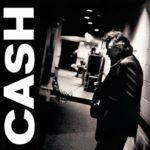
Johnny Cash continued to record with Rubin until his death on September 12, 2003, releasing two more albums during his lifetime: American III: Solitary Man and American IV: The Man Comes Around. He remains the only artist inducted into both the Country and Rock and Roll Hall of Fame, the oldest MTV VMA nominee, and the winner of 18 Grammy Awards. The photograph, which captures a rude gesture in a maximum-security prison in an era of different moral standards, retains the symbolic meaning of rebellion and the individuality of a country legend.